





Introduction — Why chase Geneva’s secret alleys and how this guide helps you
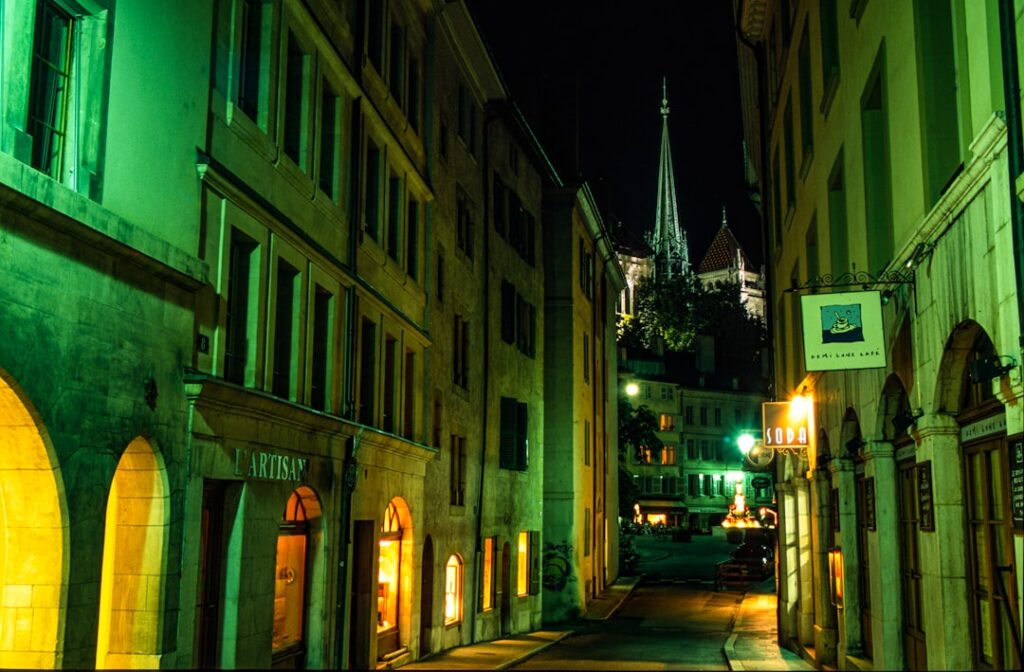
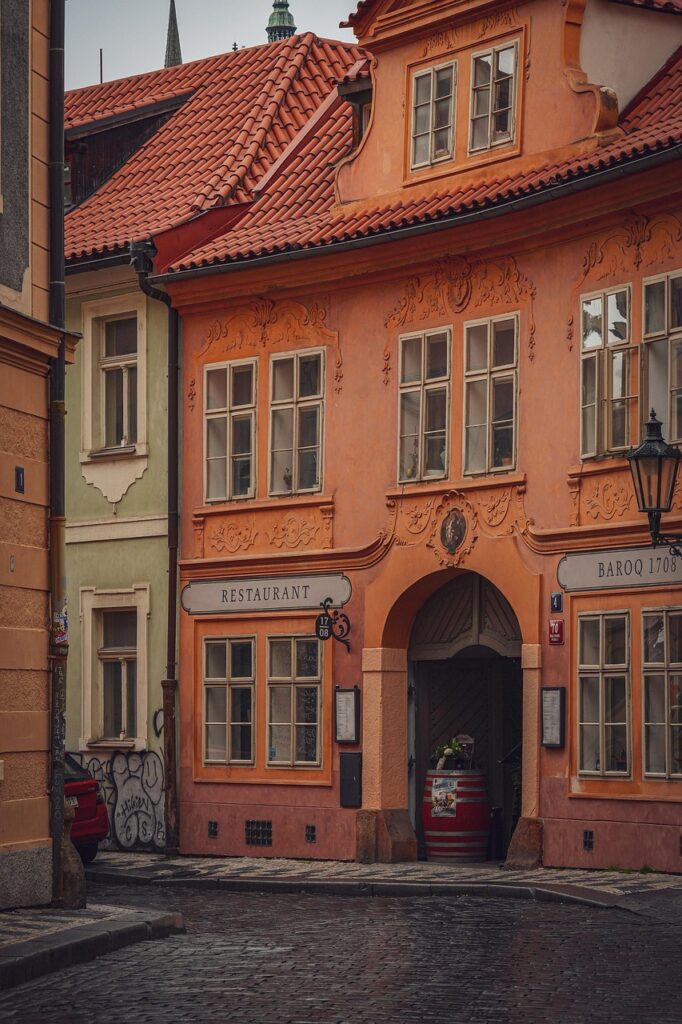
Geneva isn’t just the home of international organizations and the famous fountain that shoots water 140 meters high: it’s also a maze of discreet passageways, intimate lanes and small cobbled squares that tell the city’s story beyond the postcards. This practical guide gives you a step‑by‑step method, precise spots, suggested times, prices in euros, photo checklists and local tips so you can find and shoot 7 secret alleys in Geneva right away — even if you’re only in town for a weekend.
Instead of vague lists, you’ll find seven numbered sections (exactly 7), each focused on a specific alley: precise address (when available), how to reach it by public transport, best time for light, suggested shooting angles, recommended exposure and camera settings, little signs or façades to look for, and a mini‑checklist to make sure you don’t miss anything. Prices are thought for a European visitor: approximate public transport ticket cost in euros, a nearby coffee price, or small fees (museums, entry rights) converted into euros. Conversions are indicative and rounded to make planning easier.
This guide is structured to be used on location: every alley is followed by step‑by‑step « how to » instructions, a “before you go” checklist (camera gear, possible permits) and practical advice on respecting the local environment (don’t disturb residents, avoid intrusive night lighting, use tripods responsibly). If you do street photography, you’ll also find tips on handling subjects, a brief reminder about image rights in Switzerland, and tricks to capture textures, juxtapose materials and light, and build strong compositions.
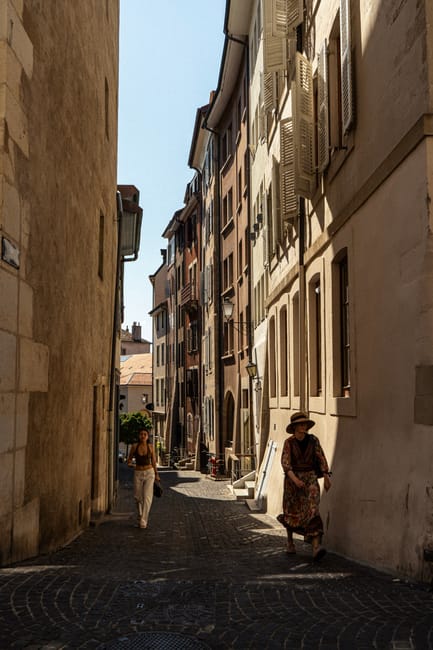
Before you head out, a few essential logistical details: the TPG (Transports Publics Genevois) network is dense and reliable — a single zone 10 ticket costs about 3 CHF, roughly €2.80 (indicative price). Many alleys are in the Old Town and Carouge, which are pedestrian‑friendly and accessible at most hours, but for the best light plan for early morning or late afternoon. Most local cafés accept card payments; expect to pay between €3 and €6 for a coffee or a takeaway snack.
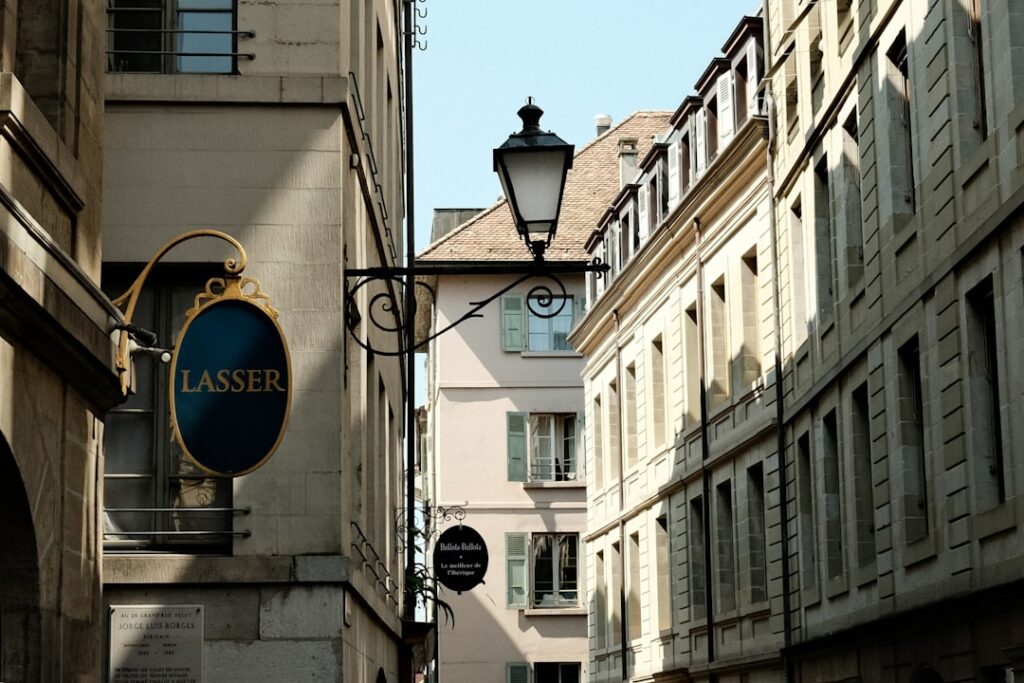
Finally, respect private spaces and follow these simple rules: no flash in intimate areas, ask permission before photographing a recognizable person (Swiss image law recommends consent for commercial use), and leave alleys as you found them. Now let’s move on to the 7 alleys, each with step‑by‑step directions.
1) Ruelle du Puits‑Saint‑Pierre — Old Town (medieval feel and aged textures)
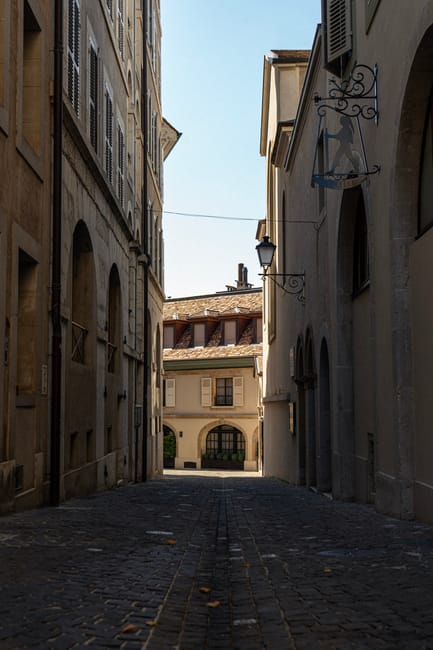
Address: Ruelle du Puits‑Saint‑Pierre, 1204 Geneva (main entrance from Rue du Puits‑Saint‑Pierre, near Place du Bourg‑de‑Four). Access: walk from Place du Bourg‑de‑Four (tram 12/18 « Bel‑Air » stop is a 6–8 minute walk) or take bus 1 to « Parc des Bastions » then 7 minutes on foot. Recommended hours: 06:30–09:00 for soft light, 18:00–20:00 for golden atmosphere. Entry fee: free.
Description: This cobbled lane, lined with honey‑coloured façades and wrought‑iron grilles, has a medieval vibe. Windows often have small wooden shutters, the stone is weathered and the paving joints are irregular — perfect for photographing patterns and repetition. Look for brass door numbers and engraved plaques for textured close‑ups.
Step‑by‑step:
- Arrive before 09:00 to avoid tourists and morning traders. Set your camera to aperture priority (f/2.8–f/5.6) to isolate a door or shaft of light; use f/8–f/11 for full scenes with deep depth of field.
- Shoot a tight vertical composition of a door + handle + wall texture (50mm or 35mm). Look for side light to bring out the roughness.
- Make a wide shot (24–35mm) standing near one end of the alley to get a perspective that leads the eye toward the center.
- Return late afternoon: the streetlights turn on and the tones warm up — switch white balance to « shade » if you want to emphasize warmth.
- Gear checklist: body with 24–70mm or 24–105mm, 50mm lens, travel tripod (if shooting early), microfiber cloth, spare battery.
- Local tip: pop into the engraving shop on Rue du Puits‑Saint‑Pierre (open 10:00–18:00) for a paper map of the Old Town. Nearby coffee price: ~€4.00.
2) Passage de la Corraterie — City centre (covered passage and urban architecture)
Address: Passage de la Corraterie, 6 Rue de la Corraterie, 1204 Geneva. Access: tram 12 « Bel‑Air » or bus 2 « Rive » stop. Recommended hours: 10:00–12:00 for a balance between light and commercial activity. Fee: free. Nearby café: Café du Centre (approx. €5–6 for a cappuccino and a small pastry).
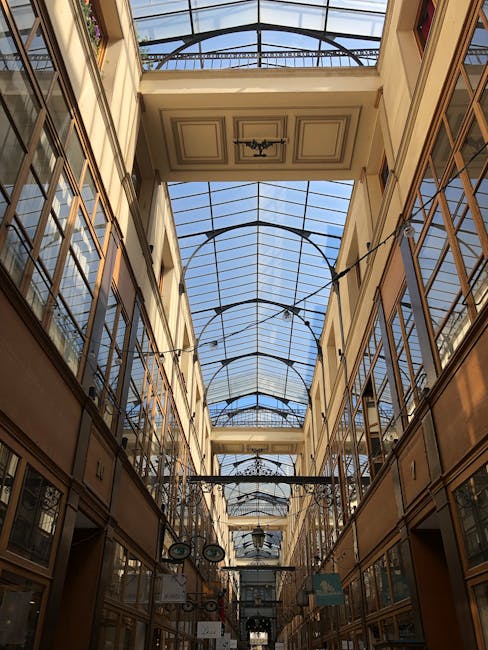
Description: Passage de la Corraterie is a covered corridor linking Rue de la Corraterie to small inner courtyards. The architecture mixes wrought iron, glass roofs and contemporary mosaics. Light refracting through the glass creates beautiful tonal ranges — perfect for playing with reflections and silhouettes. The artisan shops add color and texture — great for urban context shots.
Step‑by‑step:
- Arrive around 10:00. Bump ISO to 400 if the glass roof is cloudy. Prefer a shutter speed >1/125 to capture sharp passersby.
- Look for reflections on the floor (grout and slabs keep interesting marks) and shoot backlit scenes for dramatic silhouettes.
- Use a wide angle (24mm) to include the glass roof and leading lines; bracket exposures to pick the best before editing.
- Try an environmental portrait of an artisan or shopkeeper, being polite: ask permission and offer a print or contact card.
- Before you enter: ask permission if you want a wide shot that includes a private shop; budget €5 for a coffee if you’re welcomed inside.
- Practical info: public toilets on Rue du Rhône (paid), ATMs and banks nearby.
3) Ruelle de la Taconnerie — Old Town (artisan details and workshops)
Address: Ruelle de la Taconnerie, opening onto Place du Bourg‑de‑Four, 1204 Geneva. Access: 2 minutes on foot from the « Geneva, Vieille‑Ville » stop (tourist bus / pedestrian). Recommended hours: 09:00–11:00. Fee: free.
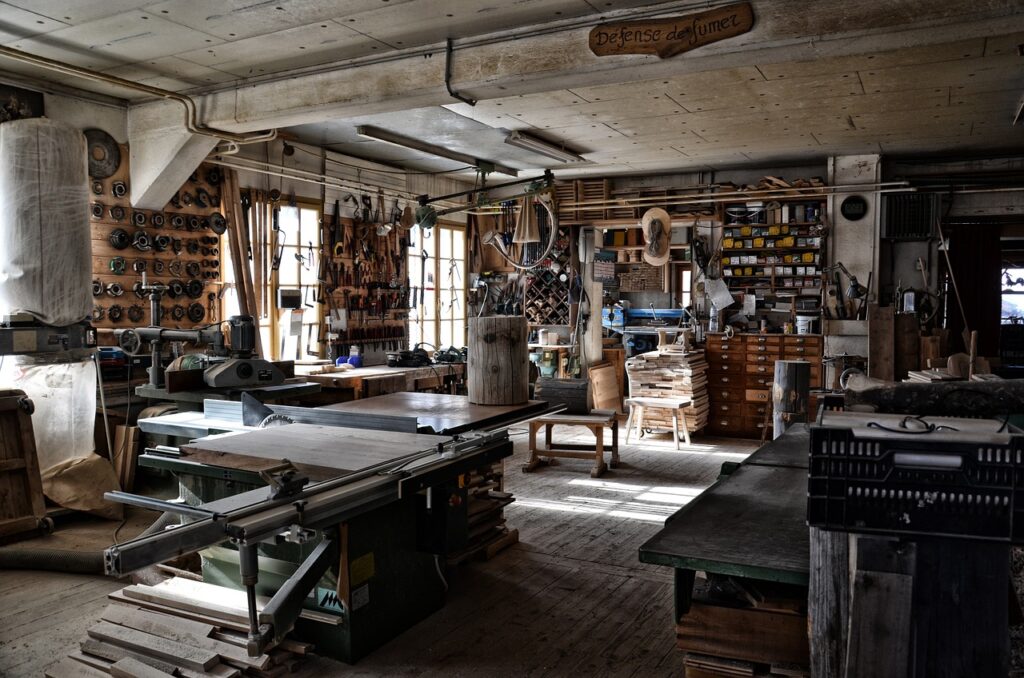
Description: Ruelle de la Taconnerie is narrow and gently sloped, lined with creator workshops and small grilles. Iron signs and tools hung on the walls give it an artisanal character. Ideal for macro and texture work: weathered workshop doors, peeling paint and an assortment of objects left by owners that tell silent stories.
Step‑by‑step:
- Start with close‑ups (macro or 50mm) of material surfaces: steel, wood, cracked paint. Open to f/2.8–f/4 to separate the subject from the background.
- Shoot verticals from a low angle to emphasize wall height and perspective. Use 35mm or 24mm depending on space.
- If an artisan is present, propose a small exchange — a printed photo or a keepsake in return for shooting (greatly appreciated locally).
- Experiment with HDR if the alley has strong contrasts between shadows and shafts of light.
- Checklist: macro lens if you have one, remote shutter release, extra memory card.
- Local tip: respect workshop spaces — many are private. If invited in, switch to silent mode and be discreet.
4) Rue Ancienne — Carouge (southern vibe and colorful façades)
Address: Rue Ancienne, 10–24, 1227 Carouge (Carouge artisan quarter). Access: tram 12 to « Carouge » or bus 18 to « Carouge, Place du Marché. » Recommended hours: 08:00–10:00 or 17:30–19:30. Fee: free. Recommended café: Café des Négociants, Place du Marché, approx. €4.50 for a coffee + pastry.
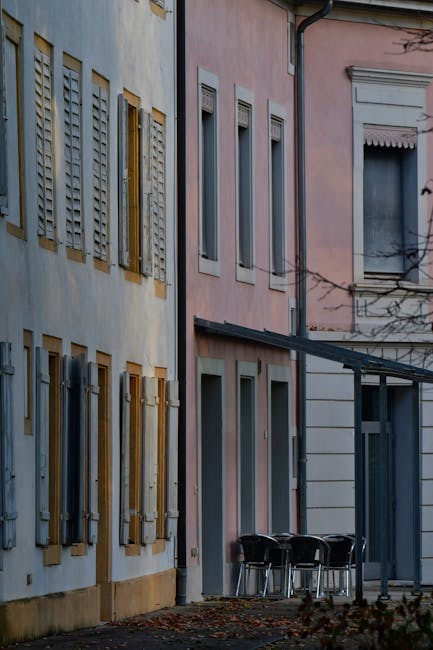
Description: Carouge is often compared to a Mediterranean town stranded in Switzerland. Rue Ancienne, in particular, is lined with pastel façades, wrought‑iron balconies and small artisan shops. The horizontal lines of the shutters and shopfronts with outdoor displays are perfect for colorful compositions and chromatic contrasts. The vibe is quieter than the Old Town, ideal for environmental portraits and detail work.
Step‑by‑step:
- Start with a walking scout to find three main compositions: a pastel façade, a café with aligned chairs, and an artisan shop. Note opening hours so you can return if needed.
- Shoot façades with side light to emphasize shutters — f/5.6–f/8 for sharpness. Use a polarizer when light is strong to deepen colors and reduce window reflections.
- Do environmental portraits: ask a café if a server will pose for a portrait in exchange for a drink — this works very well in Carouge.
- Work on symmetry and repetition: aligned windows, awnings, metal signs.
- Checklist: polarizing filter, 50mm for portraits, 24–70mm for façades, chamois cloth to keep gear clean.
- Local tip: Carouge is loved by locals for its calm — avoid bulky tripods during market hours (Saturday morning).
5) Passage des Moulins — Eaux‑Vives (striking light and modern perspectives)
Address: Passage des Moulins, access from Rue de Lausanne 24–30, 1207 Geneva (Eaux‑Vives neighbourhood). Access: tram 12 « Rive » then 7 minutes on foot. Recommended hours: 16:00–19:00. Fee: free.
Description: This passage blends rehabilitated industrial elements (historic mills) with contemporary touches. It’s perfect for photographing texture juxtapositions — brick, steel and glass. Cyclists and pedestrians use the passage, creating chances to capture motion against static surfaces.
Step‑by‑step:
- Check the entrance on Rue de Lausanne first to spot leading lines and the sun’s position late in the afternoon.
- Shooting tips: slow shutter (1/30–1/60) with panning to show movement of passersby, or very fast (>1/500) to freeze a cyclist in silhouette.
- Composition: use metal lines to lead the eye; build a three‑plane frame (textured foreground, subject, blurred background).
- Post‑processing: increase local contrast to bring out the brick and deepen shadows.
- Checklist: ND filter for long exposures in daylight, compact tripod, remote release.
- Local tip: the area gets busy around 17:30–18:30; plan according to whether you want silhouettes or empty frames.
6) Ruelle des Mange‑Coins — Saint‑Gervais district (intimate scenes and vintage signs)
Address: Ruelle des Mange‑Coins (near Rue du Vieux‑Billard, 1205 Geneva). Access: bus 5 « Saint‑Gervais » then 4 minutes on foot. Recommended hours: 07:00–09:30 for small shops and soft light. Fee: free.
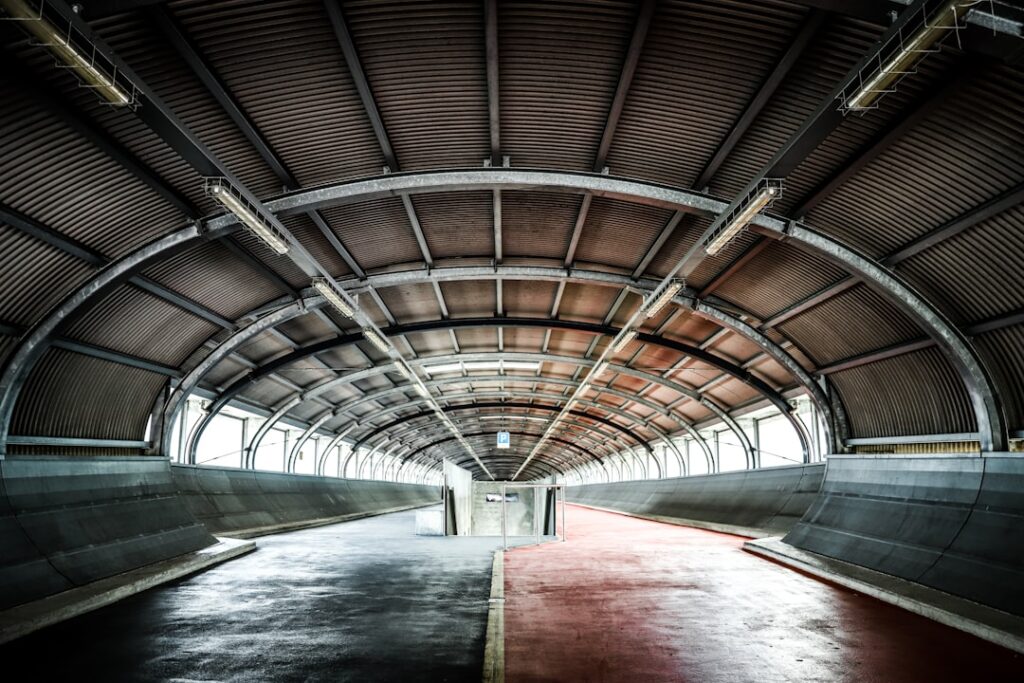
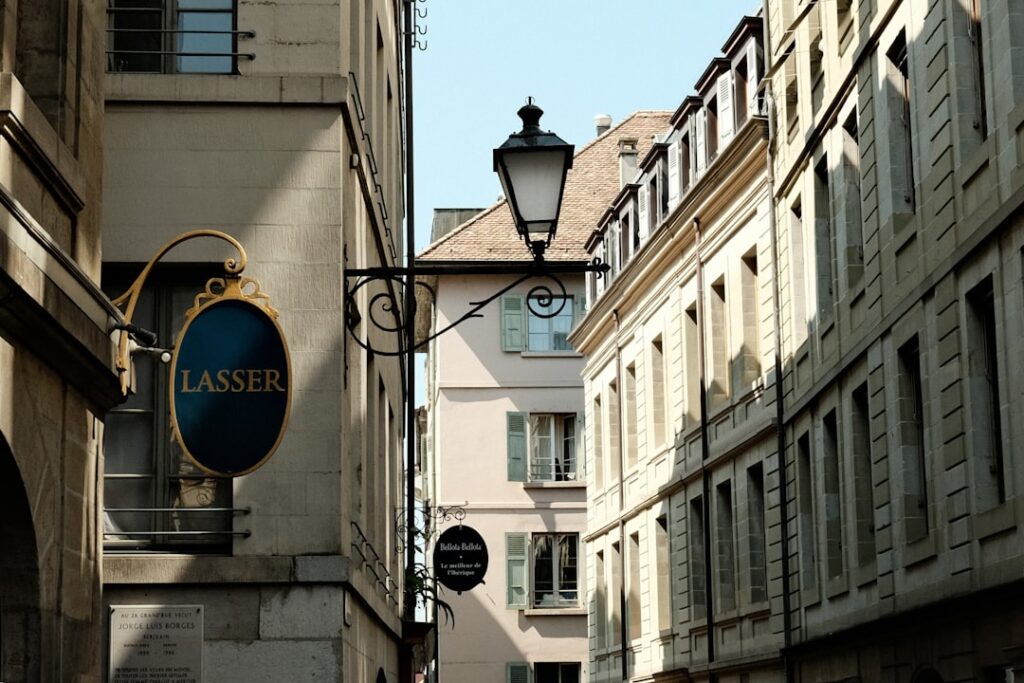
Description: A small lane that still preserves old shop signs and some half‑timbered façades. The local nickname « Mange‑Coins » is a cheeky reference to how the tiny shops seem to eat into the street space. Wait for a shop to open to capture the moment life begins, or shoot close‑ups of signs and painted lettering.
Step‑by‑step:
- Pick a composition with a traditional sign and a clean background. Use 85mm or 50mm to slightly compress the scene and isolate the sign.
- Shoot a tilted series to energize the typography (rotate the camera slightly).
- If a shopkeeper sets up their storefront, ask for a quick portrait — often accepted if you show them the result.
- Try black and white to emphasize the timeless feel of the lettering and textures.
- Checklist: 85mm lens (portraits), full battery, printed business card for exchanges.
- Local tip: many of these shops open late; if you want an empty scene, arrive before 08:00.
7) Impasse des Bains‑Vieux — Pâquis (reflections, steps and lakeside access)
Address: Impasse des Bains‑Vieux, behind Quai du Mont‑Blanc, 1201 Geneva. Access: tram 15 « Molard » or a 10–12 minute walk from Gare Cornavin. Recommended hours: sunrise (05:30–07:30) or dusk (20:00–22:00) for water reflections and city lights. Fee: free.
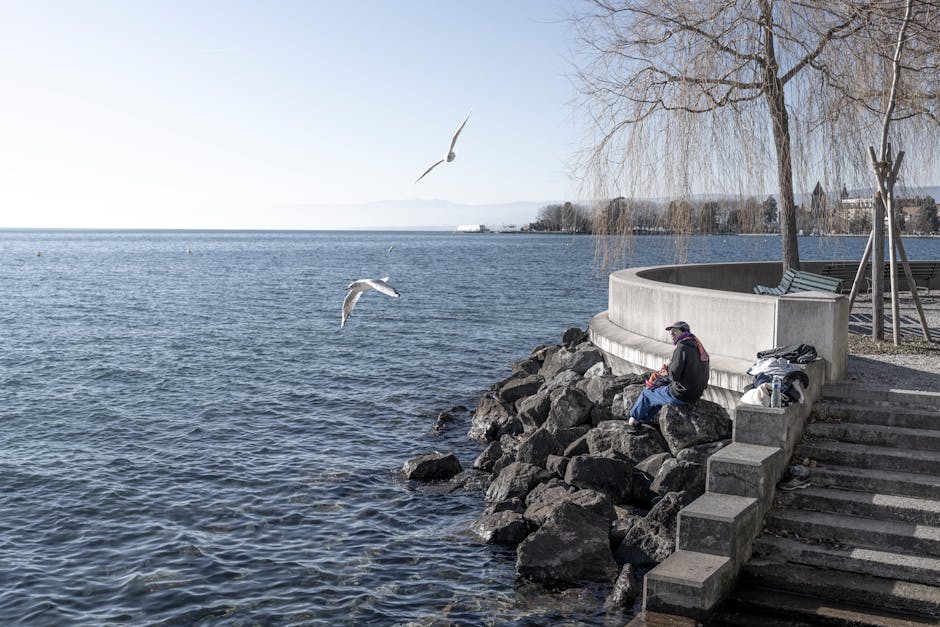
Description: A small cul‑de‑sac that gives discreet access to the shores of Lake Geneva with a staircase that sometimes leads to secondary landing stages. Water reflections, old service doors and lamp posts create an ideal nocturnal palette. The spot is perfect for long exposures and for capturing the city‑lake relationship.
Step‑by‑step:
- Arrive 30 minutes before sunrise to catch the color transitions. Set ISO 100–200, use a tripod and f/8 for sharpness.
- Shoot 1–10 second exposures to smooth the water and get soft reflections (ND filter if it’s still bright).
- Compose with the staircase in the foreground to lead the eye toward the lake and the silhouette of the Jet d’Eau in the background (if visible from your spot).
- At night, locate and stabilize bright points: lamp posts, boat lights, shop windows. Take multiple exposures for potential HDR blending.
- Checklist: sturdy tripod, remote release, ND filter, headlamp for safe adjustments.
- Local tip: the Pâquis area livens up in the evening; for quieter images, prefer dawn.
Conclusion — Best practices recap and a sample half‑day or full‑day schedule
You now have a concrete roadmap to explore 7 secret alleys in Geneva. To get the most out of this list, plan your day around the light: start at dawn at Impasse des Bains‑Vieux (section 7) for lakeside reflections, continue to the Old Town (sections 1 and 3) for medieval atmosphere and workshops, then head to the centre and the Corraterie (section 2) for covered passages mid‑morning. After lunch in Carouge (section 4) where colorful façades provide a pleasant contrast, go to Eaux‑Vives (section 5) and finish the day at Ruelle des Mange‑Coins (section 6) for vintage signs and local portraits in the late afternoon.
Sample day plan:
- 05:30–07:30: Impasse des Bains‑Vieux (dawn reflections)
- 08:00–10:00: Ruelle du Puits‑Saint‑Pierre & Ruelle de la Taconnerie (Old Town)
- 10:30–12:00: Passage de la Corraterie (covered passage)
- 12:30–14:00: Lunch in Carouge + Rue Ancienne
- 15:00–17:00: Passage des Moulins (Eaux‑Vives)
- 17:30–19:00: Ruelle des Mange‑Coins (portraits, signs)
- 19:30–21:00: Back to Impasse des Bains‑Vieux or lakeside for dusk
Final practical tips: always have a TPG ticket (zone 10) handy — approx. 3 CHF ≈ €2.80; carry small change (€1–5) for coffees and tips. Respect people’s privacy: always ask before photographing someone up close. Back up your images every evening (hard drive or cloud) and note the time and weather of each shot to make culling and editing easier later.
Happy exploring — and remember that the charm of Geneva’s alleys lies as much in the tiny details as in the stories they hold. This guide helps you find them, frame them and respect them. Share your best shots with local shopkeepers — they’ll be delighted and may even point you to new secret corners to discover.